
As a parent, you want the best for your child, including a healthy, confident smile that lasts a lifetime. If your teenager needs orthodontic treatment, you’ve likely weighed the pros and cons of traditional braces versus Invisalign. While metal braces have been the clinical standard for decades, Invisalign has become the preferred alternative for modern teens and their parents.
But how do you know which path is right for your child? Understanding the key differences in lifestyle, hygiene, and results can help you make the best decision for your teen’s busy schedule.
A Faster, More Precise Timeline
Traditional braces are effective, but they often come with a long-term commitment. Depending on the complexity of the case, braces can take several years to fully align the teeth. For a teenager balancing school, sports, and a social life, this can feel like an eternity.
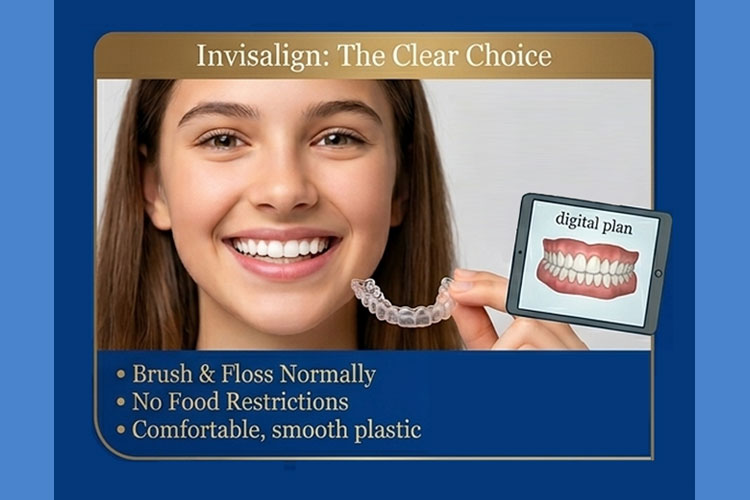
In contrast, Invisalign often offers a faster treatment timeline. Because the entire process is digitally planned with 3D mapping, each movement is highly precise. Many teens achieve their desired results more efficiently than they would with traditional wires and brackets. While every smile is unique, this shorter duration is a significant “win” for both you and your teen.
Prioritizing Oral Health and Hygiene
One of the biggest challenges with braces is maintenance. Brackets and wires act as magnets for food particles and plaque, making brushing and flossing a tedious chore. If hygiene slips, it can lead to:
- Gum Inflammation: Swelling and irritation from trapped bacteria.
- Demineralization: Permanent white spots on the enamel once the braces are removed. These can lead to numerous cavities later in life.
- Discoloration: Uneven staining around the bracket areas.
Invisalign removes these obstacles entirely. Because the aligners are removable, your teen can brush and floss normally. There’s no need for specialized threaders or other tools. This ensures their teeth stay bright and their gums stay healthy throughout the entire transition.
Comfort and Lifestyle Flexibility
We’ve all heard stories of poked cheeks and broken wires. Traditional braces involve metal components that can cause sores and irritation, especially after a “tightening” appointment. Invisalign aligners are made of smooth, medical-grade plastic custom-fitted to your teen’s mouth, significantly reducing physical discomfort.
From a lifestyle perspective, Invisalign offers two major perks:
- No Food Restrictions: With braces, popcorn, sticky candy, and hard snacks are off-limits. With Invisalign, your teen simply pops out the trays and eats whatever they like.
- Fewer Office Visits: Busy families appreciate that Invisalign typically requires fewer in-office adjustments. Teens receive several sets of aligners at once and advance through them at home based on their dentist’s instructions.
The “Confidence” Factor
The teenage years are often a high-stakes period for self-image, where even small changes can feel magnified. During this sensitive time, the “Confidence Factor” of Invisalign becomes a game-changer. Unlike traditional braces, which can become the focal point of a teen’s face, the “invisible” nature of clear aligners allows their natural smile to take center stage. This discretion is especially impactful during major milestones like school photos, prom, or graduation, where teens want to look their best without the distraction of a “metal mouth”. Beyond these big events, the benefit extends to daily life, whether they are giving a presentation in class, participating in sports, or simply hanging out with friends. By removing the fear of being teased or feeling “different,” Invisalign allows teens to focus on their experiences rather than their orthodontics, fostering a sense of self-assurance that lasts long after the treatment is complete.
The Responsibility Requirement: Growing Together
While Invisalign offers more freedom, it does require a consistent level of maturity to be effective, as aligners must be worn for 20 to 22 hours per day. Rather than simply wondering if your child is ready, this is a great opportunity to work alongside your teen to help them build the responsibility needed for success. By setting up a proper routine together, you can turn their smile transformation into a shared project. A collaborative approach not only ensures the treatment stays on track but also helps your teen develop valuable habits in self-discipline and health management.
In conclusion both braces and Invisalign are effective orthodontic treatments, but Invisalign offers several advantages that make it especially appealing for today’s teenagers. With faster treatment times in many cases, improved comfort, easier oral hygiene, and greater flexibility, it provides a modern solution for achieving a healthy, beautiful smile. If your child is ready to commit to wearing their aligners as instructed, Invisalign is often a smart and practical choice for completing their orthodontic treatment.
Keywords: Invisalign for teens, teen orthodontics, clear aligners, braces vs Invisalign, dental hygiene, orthodontic treatment, teen dental care, straight teeth