

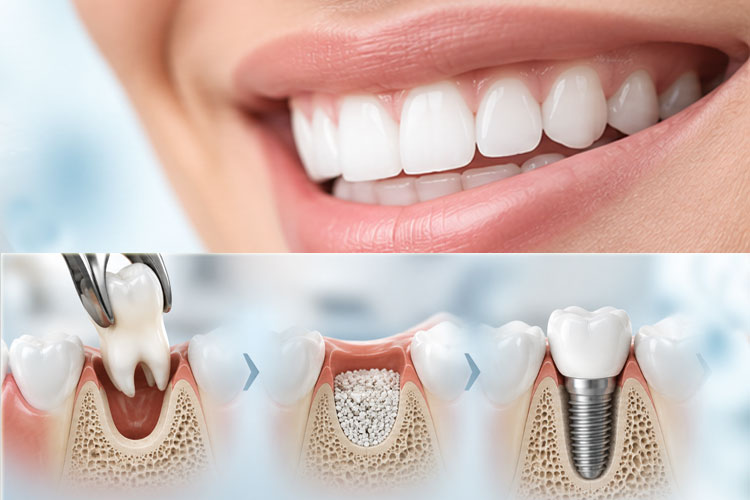
When a tooth needs to be removed, it is natural to focus primarily on the immediate problem which is relieving pain, treating infection or removing a tooth that can no longer be restored. However, what happens after the extraction can be just as important, especially when the missing tooth will eventually need to be replaced. The roots of natural teeth play an important role in maintaining the surrounding jawbone. Once a tooth is removed, the bone in that area no longer receives the same stimulation and gradually begins to change in shape and volume. For this reason, planning for future tooth replacement should ideally begin at the time of extraction. Preserving the extraction site through bone grafting or socket preservation can help maintain the foundation needed for a dental implant, dental bridge or other future restoration.
What Happens to the Bone After a Tooth Is Removed?
A tooth is supported by the alveolar bone, the portion of the jawbone that surrounds and holds the tooth roots. Following an extraction, the body naturally begins healing the empty socket. During this process, however, some of the surrounding bone can be resorbed because it is no longer supporting a natural tooth. Over time, the ridge may become narrower or lose height. The amount of change varies from one patient to another and depends on factors such as the location of the tooth, condition of the surrounding bone, infection, gum health, and individual healing. These changes are part of a natural biological process, but they can affect the shape of the gum and underlying ridge and therefore become important regardless of how the patient ultimately chooses to replace the missing tooth.
How Bone Grafting Can Help Preserve the Extraction Site?
Bone grafting performed at or around the time of tooth extraction is often referred to as socket preservation. After the tooth is carefully removed, an appropriate bone grafting material may be placed within the extraction socket to support healing and help preserve the dimensions of the ridge. Depending on the individual situation, the area may also be protected with a membrane or other material while healing takes place. The objective is not simply to fill the space left by the tooth. Rather, socket preservation is intended to help maintain the architecture of the area and reduce the degree of bone loss that can occur following extraction. For this reason, when a tooth other than a wisdom tooth requires extraction, it is important to discuss bone preservation with your dentist as part of the long-term restorative plan.
Bone Grafting Is Not Just for Dental Implants
A common misconception is that preserving the bone after extraction matters only when a patient intends to receive a dental implant. In fact, maintaining the shape and volume of the jawbone can also be valuable when a dental bridge is planned. If the bone beneath a missing tooth shrinks significantly after extraction, the gum and ridge can develop a sunken or “caved-in” appearance. Because the replacement tooth of a bridge rests visually over this area, loss of the underlying ridge can make it more difficult to create a restoration that looks as though a natural tooth is emerging from healthy gum tissue. Preserving the extraction site can help maintain a fuller ridge contour, providing better support for the surrounding soft tissues and potentially allowing the final bridge to achieve a stronger, more natural and aesthetically pleasing appearance. Bone preservation should therefore be considered as part of the overall restorative plan, and not simply as preparation for an implant.
Why Bone Preservation Matters for Future Dental Implants?
For patients choosing an implant, bone preservation becomes especially important because a dental implant is placed directly within the jawbone and relies on adequate bone for proper positioning, stability, and long-term support. If substantial bone loss has occurred after an extraction, there may not be enough bone volume to place an implant in the desired position without additional treatment. In some situations, bone augmentation can still be performed later, but this may add another procedure and extend the overall treatment timeline. Preserving the ridge at the time of extraction may simplify future implant treatment and give the dentist greater flexibility when determining implant size and position. This is why future tooth-replacement options should ideally be discussed before the tooth is extracted, even when the patient is not yet ready to proceed with the final restoration.
Conclusion
Tooth extraction should not always be viewed as the end of treatment. Whether a missing tooth will eventually be replaced with a dental implant or a dental bridge, preserving the underlying bone can be an important part of achieving a functional and natural-looking final restoration. Addressing bone preservation at the time of extraction may help maintain the shape of the jaw and gums, reduce ridge collapse, and provide a better foundation for future restorative treatment. At Joobbani Dental Designs, we believe successful tooth replacement begins with careful planning from the very start. Dr. Joobbani and our experienced dental team provide comprehensive care that includes tooth extraction, bone grafting and socket preservation, implant planning, dental implants, and restorative treatment. Using advanced digital technology, modern techniques and individualized treatment planning, we consider not only the immediate reason for removing a tooth but also how the area will look and function in the years ahead. If you have been told that a tooth needs to be extracted, contact Joobbani Dental Designs to discuss bone preservation and your future tooth-replacement options before the extraction.
Keywords: bone graft after tooth extraction, socket preservation, dental implant, bone preservation, jawbone loss, bone loss after tooth extraction, dental implant bone graft, tooth extraction, jawbone preservation, implant dentistry